
 Please wait...


entertaining read. I like at most:
- "You're correct in your assertion that framed data would mean clean binary transfers, but that isn't a goal of XMPP - anyone shipping binary data directly through XMPP is simply doing something inefficient. If you do want to ship large binary objects, it's more efficient to send them either via email, or send a URL via XMPP, and ship the data by a more suitable protocol."
Binary, Email and efficient in one sentence, that could only be said by an XML-Zealot.
Screwing around with my Pi a little more.
It has a very nice graphics card in it, so I want to compile omxplayer so I can fart around with the graphics capabilities from source.
I probably should have stuck with g++ instead of trying to move to clang, though. I don't think clang likes the standard library currently installed.
Heh... sadly, even g++ is having trouble compiling this on the Pi itself.
Hmm... should be able to do this.
That's unlikley to stop me in the long run, though.
Mon Nov 11 2013 02:09:14 EST from the8088er @ UncensoredI've been thinking about getting a Pi but I don't know what I'd do with it and I already have a host of other UNIX/Linux machines that run 24/7 and do nothing.
That's unlikley to stop me in the long run, though.
the pi or the olimexino or qubieboard can do the same for a much smaller footprint on your electricity bill.
It's quite light on the bill.
Finally got the omxplayer to compile properly... helps to make sure gcc and g++ are linked to 4.7 and not 4.6.
with it and I already have a host of other UNIX/Linux machines that runYes, but do they do nothing in a small form factor?
24/7 and do nothing.
Well here's the best Pi case I've seen so far:
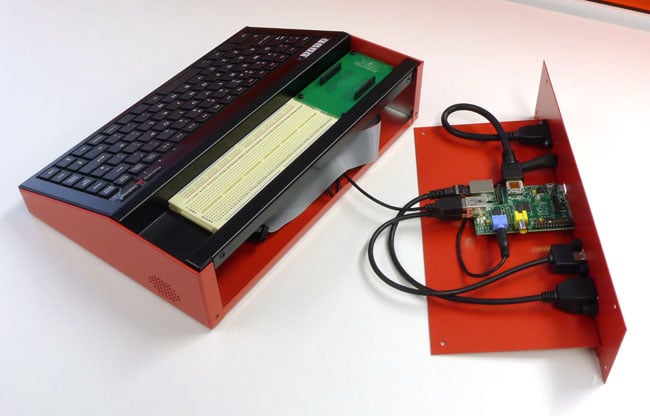
[ http://www.theregister.co.uk/2013/11/11/review_raspberry_pi_fuze_case_and_kit/ ]
They've built it out as an old-skool keyboard console, like from the 1980's. The Pi fits in the back, has all of the ports fitted to nice receptacles on the back of the unit ... and then they've got a breadboard up top with the GPIO pins available right next to it.
This has to be the ultimate setup for any nostalgic fortysomething geek!
Mon Nov 11 2013 17:00:27 EST from IGnatius T Foobar @ Uncensored Subject: ultimate Pi caseWell here's the best Pi case I've seen so far:
[ http://www.theregister.co.uk/2013/11/11/review_raspberry_pi_fuze_case_and_kit/ ]
They've built it out as an old-skool keyboard console, like from the 1980's. The Pi fits in the back, has all of the ports fitted to nice receptacles on the back of the unit ... and then they've got a breadboard up top with the GPIO pins available right next to it.
This has to be the ultimate setup for any nostalgic fortysomething geek!
probably the cables to connect everything to the back of the device is as expensive as an olimexino costs more than a pi - and it has all important sockets on one side, plus it features the olimex UEXT connector which you can find lots of open expansion designs for.
Jesus H.! That is a nice case!
But also Jumping H, $110 US? We need to come up with a way to make the rack of bits cheaper than that.
hm, I think i'm falling in love with collectd.
https://collectd.org/wiki/index.php/Plugin:Tail/Config
maybe missing some basic features to hack there, but SO CUTE!
But also Jumping H, $110 US? We need to come up with a way to make
the rack of bits cheaper than that.
Well, I'm sure you could build something. I'm totally cheap so I'd probably go that route. It's not that hard to build a box out of wood or even plastic/metal that can house a USB keyboard. Mine would have to have a ton of LED's all over the place.
Of course, if you want a *real* retro look, you could always dismantle an old Apple and buy one of these (very expensive) boards to interface its keyboard to the Pi: [ https://www.tindie.com/products/option8/retroconnector-keyboard-shield-for-apple-iie/ ]
Not for me, though. I cut my teeth on CP/M and S-100, so I would need a key-switch for power and a reset button that glows white.
Well, this is an interesting milestone.
The ethernet switch in my basement died this morning. And upon trying to find a workaround I came to the realization that I only need three ports: one for my main computer, one for a phone tied to the VoIP system at work, and one running to the printer upstairs.
Between not needing a home lab anymore (why bother when every possible test I might want to run can be done virtualized?), having ditched VoIP at home, everything else being wireless, and simply not giving a **** anymore about whether my basement exudes geek-pride anymore ... it seems that the handful of ethernet ports built into the router is enough.